

Classrooms, especially in early education, are naturally lively environments. Curiosity, conversation, movement, and excitement fill the room every day. While that energy supports learning, it can also create sound levels that make it hard for students to focus, hear instructions, or feel calm.
For schools that can’t take on construction or large-scale redesigns, improving classroom acoustics may seem out of reach. But it doesn’t have to be. With the right tools and acoustic adjustments, it’s completely possible to create quieter, more comfortable learning spaces without major renovations. That’s where early education acoustic solutions from MergeWorks make a meaningful difference.
Why Classroom Acoustics Matter in Early Education
Young learners are still developing auditory processing skills, and many rely heavily on clear speech to understand lessons. Excessive background noise can interfere with their ability to distinguish important information from distractions. For students with hearing differences, auditory processing challenges, or language barriers, poor acoustics can turn even simple instructions into a struggle.
Teachers feel the impact too. Speaking over classroom noise all day, every day, increases vocal strain and makes it tougher to maintain a calm environment. When a room naturally supports clearer sound and less reverberation, teaching becomes easier, and students stay more engaged. Effective acoustic solutions don’t need to be complicated. Often, the most impactful changes are simple additions that absorb noise, reduce echo, and soften the soundscape.
Use Acoustic Wall Panels to Improve Speech Clarity
One of the most effective ways to quiet a classroom without altering the structure is by adding acoustic wall panels. Wall panels absorb sound instead of allowing it to bounce around the room, which is especially important in classrooms with hard surfaces like tile floors, brick walls, or large windows.
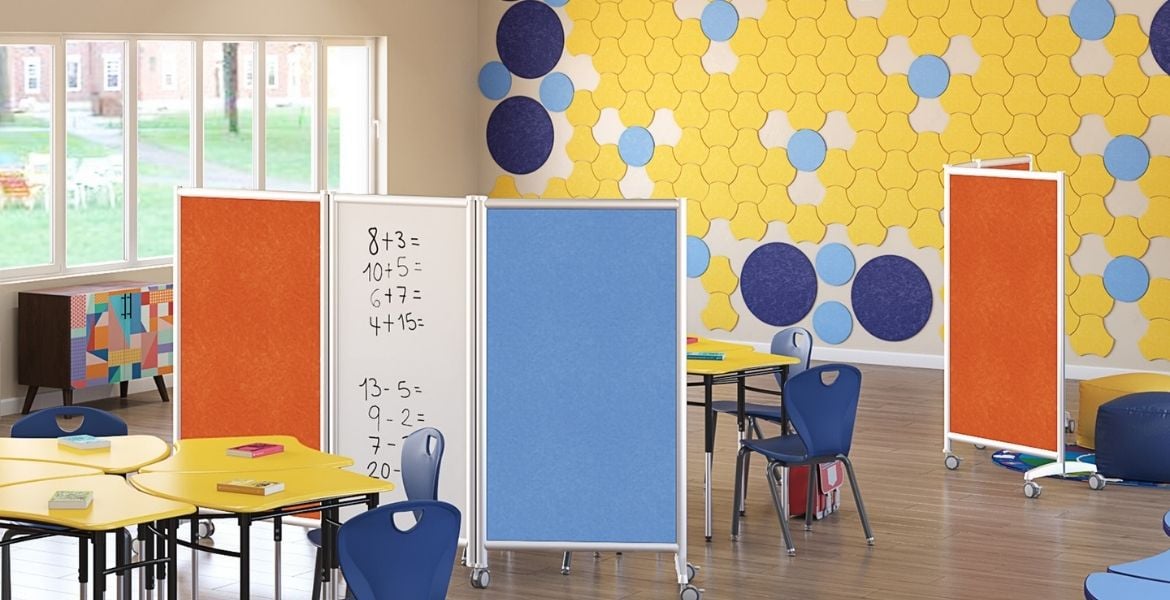
Acoustic wall panels, such as MergeWorks’ EchoDeco Shapes help to create a more balanced sound by cutting down on reverberation. Students hear teachers more clearly, group discussions stay more manageable, and sudden bursts of noise become less jarring. For classrooms that need flexibility, stations, circle time, small groups, wall panels are a smart choice. They can move with classroom layouts as learning needs change.
Reduce Classroom Clutter to Lower Sound Levels
Classroom acoustics aren’t shaped only by noise itself. They’re also influenced by how sound interacts with the room. Overstimulating, overcrowded, or cluttered spaces often feel louder because sound bounces off surfaces more easily.
A quieter classroom doesn’t have to mean an undecorated one. Instead, it means being more intentional about what goes on walls and shelves. Soft materials, plants, rugs, and fabric elements reduce echo naturally.
Teachers can also incorporate sound-friendly organization strategies such as:
- Using soft bins or baskets instead of hard plastic containers.
- Adding small rugs or mats to reading areas.
- Choosing fabric-backed boards instead of bare wall displays.
- Arranging furniture to break up large open areas where sound travels easily.
These small adjustments help create a more acoustically balanced room without sacrificing the warmth and personality that early education spaces should have.
Divide Space with Room Dividers
Classrooms often function as multi-purpose environments. During a single day, the room may shift from reading groups to science experiments to free play. These transitions can raise overall noise levels, especially when students share the same open space.
MergeWorks Room Dividers help create natural boundaries within the room, which reduces sound transfer and gives students defined areas where they can concentrate.
Some practical ways teachers use acoustic partitions include:
- Creating Quiet Corners: Perfect for reading, tutoring, or calm-down spaces.
- Separating Activity Stations: So sound from one group doesn’t overwhelm others.
- Forming Semi-Private Areas: Best for small group instruction.
Our popular Urban Wall doesn’t require any strenuous work and can be customized to your classroom’s setup. Teachers can adjust their placement daily, making them an ideal addition to any set of early education acoustic solutions.
Use Soft Seating and Flexible Furniture to Reduce Noise
Furniture plays a bigger role in classroom acoustics than many people realize. Hard-surface chairs and tables amplify sound, especially when students move frequently. Simple swaps—like adding felt pads under chair legs or incorporating soft seating options—help minimize scraping and impact noise.
Flexible, cushioned furniture also makes reading nooks, breakout zones, and sensory corners naturally quieter, giving students places where they can reset and refocus.
A Quieter Classroom Supports Better Learning
When classrooms sound better, everyone benefits. Students hear instructions more clearly, teachers feel less strain, and the overall learning environment becomes calmer and more productive. With the right acoustic solutions and products, early education classrooms can create meaningful improvements without disrupting the academic year or stretching budgets.
Ready to get started? Reach out to our team by calling 800.597.1195 or find a rep near you!


